How Many Props Is Too Many in One Pose?
Quick Answer: The useful limit is however many props still leave one clear job for your body to do. In restorative practice, four or five props is normal and correct because the goal is total support. In active practice, more than two usually means the shape has been rebuilt rather than adapted — and the pose stops training what it was meant to train.
Two blocks, a strap, a bolster, and a folded blanket later, the pose finally feels right.
The honest question is whether you are still doing the pose, or sitting in a very elaborate chair.
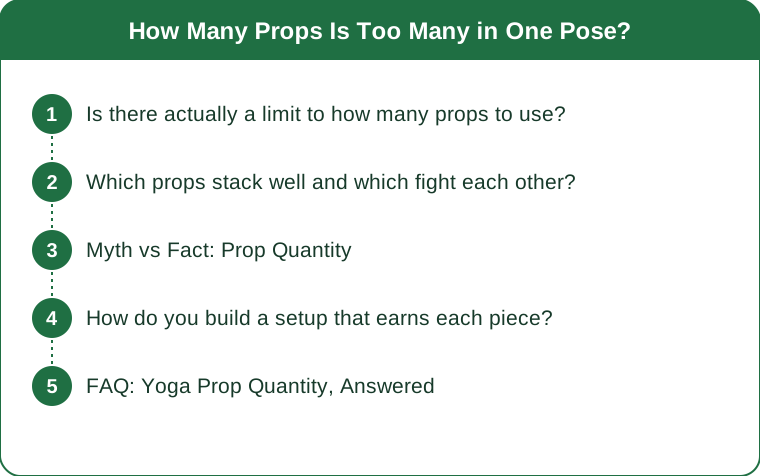
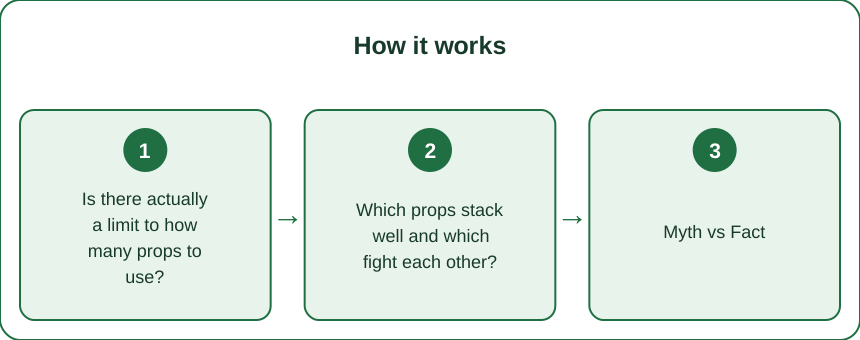
Is there actually a limit to how many props to use?
Not a number — a test. The limit is whether your body still has a job.
Every prop removes a demand. A block under the hand removes a reaching demand; a bolster under the knees removes a hamstring demand. That is the point, and it is exactly why props work. But if you remove every demand, nothing is being trained and nothing is being stretched.
Restorative and active practice have opposite answers. In a restorative pose held for 5 minutes, the goal is for the body to do nothing at all — four or five props is often the correct setup, and under-propping is the more common error. In an active practice, props should adapt a shape you are working in, not replace it.
The test is a simple one: what is still working? Name one thing your body is doing in the pose — lengthening, stabilizing, breathing into a restricted area. If you can name it, the setup is right. If you cannot, remove a prop.
Setup time is its own signal. If arranging the props takes longer than the hold, and the practice is not restorative, the shape has become the project rather than the pose.
Stability is not the same as support. Props that make a pose stable let you go deeper into it. Props that make it comfortable in every direction stop it being a pose at all. The distinction is worth carrying.
Which props stack well and which fight each other?
Some combinations compound; others cancel out.
Block plus strap: the most reliable pair. The block sets height and the strap sets distance. They control two different variables, so they add rather than overlap.
Bolster plus blanket: complementary in restorative. The bolster sets the shape, the blanket fine-tunes the height and adds warmth. Adding a blanket under the head to a bolster setup is nearly always an improvement.
Two blocks at different heights: often one too many. If the second block is compensating for the first being the wrong height, use one block at the right setting instead. This is the most common source of an unnecessarily complicated setup.
Wall plus block: excellent, and underused. The wall gives feedback that no free-standing prop can, and a block adds the height adjustment the wall cannot. Two props doing genuinely different jobs.
Strap plus bolster in an active pose: usually contradictory. The strap pulls you into a shape and the bolster supports you out of it. If you need both, the pose itself is probably the wrong choice for the day.
Myth vs Fact: Prop Quantity
Myth: Using more props means you are less advanced. Fact: Experienced practitioners generally use more props, not fewer, because they know what each one changes. Iyengar practice is prop-heavy at every level. The number tells you about the intention, not the ability.
Myth: A restorative pose should have as few props as you can manage. Fact: Restorative poses are under-propped far more often than over-propped. If any muscle is holding you in place, add support. The nervous system response you are aiming for requires that nothing is working.
Myth: If it feels comfortable, you have used too many. Fact: Comfort is the goal in restorative practice and a warning sign in active practice. Same sensation, opposite meaning — which is why the style of practice has to be part of the judgment.
Myth: Props should be removed as you improve. Fact: Some are, and some are permanent for good structural reasons. Limb proportions and joint shape do not change with practice. A block that compensates for a long femur is a permanent tool, not a training wheel.
Myth: Setting up takes away from the practice. Fact: Deliberate setup is practice. The thing that costs you is setting up mid-pose, which interrupts the breathing pattern that makes the hold work — the third mistake here is one that even careful practitioners repeat every session.
How do you build a setup that earns each piece?
Add one at a time and test whether it changed anything.
Start with the pose, unpropped, for three breaths. You need to know what the actual limitation is before you can choose the tool. Most people prop for the limitation they expect rather than the one they have.
Add the single prop that addresses the biggest limitation. Usually height under the hands or hips. Re-test for three breaths.
Only add a second if you can say what it changes. Out loud, in a sentence: this strap lets my shoulders stay down. If you cannot finish the sentence, do not add it.
Set everything up before you enter the pose. Fumbling for a block mid-pose costs you the breathing rhythm and usually results in a worse setup than deciding in advance.
Write down the setup that works. Block height, strap length, blanket folds. The setup that worked in June will need adjusting in October, and having a baseline makes the adjustment obvious rather than a fresh guess. If you have a joint injury or a recent surgery, work with a teacher on prop setups rather than experimenting alone. This is general information, not medical advice.
FAQ: Yoga Prop Quantity, Answered
How many props is normal for a restorative pose?
Three to five is typical and correct — often a bolster, one or two blankets, and a block or eye pillow. The goal is complete support, so the guiding question is whether any part of you is still holding on, not whether the pile looks excessive.
Should I use fewer props as I get more flexible?
Sometimes, for the props addressing mobility. Props addressing proportion — long limbs, a short torso, hip socket shape — stay useful indefinitely because the underlying structure does not change. Expecting to outgrow all of them sets up an unnecessary disappointment.
Is it bad if setting up takes longer than the pose?
In active practice, that is a signal to simplify. In restorative practice, it is completely normal — a 10-minute supported backbend can reasonably take three minutes to arrange, and rushing the setup is what makes the hold uncomfortable.
TL;DR:
- The limit is not a number: it is whether you can name one job your body still has in the pose.
- Restorative practice wants full support and is usually under-propped; active practice wants adaptation, not replacement.
- Blocks with straps and bolsters with blankets stack well; two blocks at different heights usually means one wrong height.
- Add one prop at a time and finish the sentence ‘this prop lets me…’ before keeping it.
Props are not a measure of anything. They are variables, and knowing which one each piece controls is the whole skill.
See It in Motion
Seen here: High Waist Bootcut Yoga Pants — shop it on bubblelime.com
Keep Reading
This article is for general informational and styling purposes only. Fit, sizing, and product availability may vary.