Why Props Behave Differently on a Thick Mat Than a Thin One
Quick Answer: A block on a 6mm mat sits on a nearly rigid surface and transmits your weight straight to the floor. The same block on a 12 to 15mm cushioned mat sinks in unevenly under load, tilts, and effectively loses 3 to 5mm of height — enough to change which muscle is working in a pose. Thick mats are kinder to knees and worse for props. If your props suddenly feel wrong, check what changed underneath them before you change the height.
It is one of the most common invisible variables in a home practice.
And it explains why a pose that felt perfect at the studio feels off in your living room.
What does the mat under a prop actually change?
Two things: the effective height, and the stability.
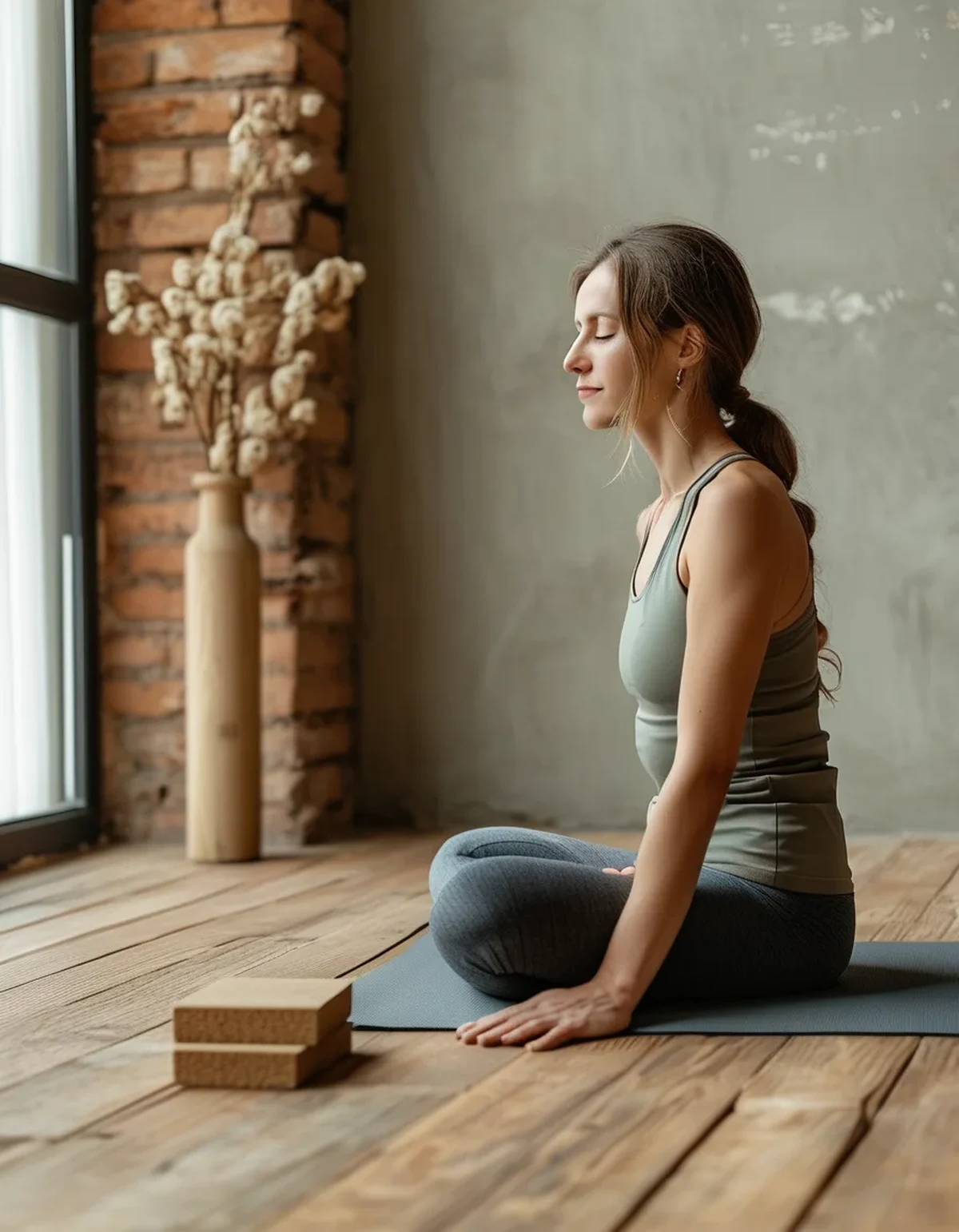
A foam or cork block is essentially rigid. A thick mat is not. Put your body weight through the block and the mat compresses underneath it, and because your weight is rarely perfectly centred, it compresses unevenly. The block sinks and tilts at the same time.
On a 12 to 15mm cushioned mat you can easily lose 3 to 5mm of effective height, and in a pose where you chose a block height deliberately, that is a real difference — the gap between your hand resting and your hand actually loading.
The tilt matters more than the sink. A block that tips by even a couple of degrees changes the angle of your wrist, or where the weight lands in your palm, or how your hip sits on a bolster. Your body then makes a small correction somewhere else in the chain, usually without you noticing, and the pose you are in is no longer the pose you set up.
Why does this show up most in standing poses?
Because standing poses put the most weight through the smallest prop contact area.
In a supported triangle or half moon, a large share of your bodyweight goes through one block. That is a lot of force through a footprint about the size of a paperback. On a soft mat, that block is going to sink and tilt, and because you are balancing on one leg at the same time, the wobble propagates immediately.
Compare that to a restorative pose. A bolster under your knees is carrying a fraction of your weight over a much larger area, and the mat underneath barely notices. That is why restorative practice on a thick mat is genuinely lovely and standing balance work on the same mat is a fight.
A useful rule of thumb:
- Standing and balancing poses: the thinner and firmer the surface under the prop, the better
- Seated and supine poses: thickness is fine, and often preferable
- Kneeling poses: thickness helps your knees, so keep it and adjust the prop height instead
Why props feel unstable on a thick mat even when they are not moving
Because your nervous system is reading the surface, not the prop.
Balance relies heavily on feedback from the sole of the foot and from the joints — small, fast signals about where your weight is going. A firm surface returns those signals crisply. A soft surface damps and delays them, and the brain responds by increasing muscular stiffness at the ankle and hip as a precaution.
The practical experience is a pose that feels harder and less settled even though nothing has actually slipped. People usually interpret this as their balance being worse that day. It is more often the surface.
This also means a thick mat makes balance work more challenging, which is not necessarily bad — it is a legitimate training stimulus, as long as you know that is what you chose. What is unhelpful is unknowingly practising a supported balance pose on an unstable surface, wondering why the prop is not helping, and gradually deciding you cannot do the pose.
Why props feel unnecessary until the third minute of a hold
Because early in a hold you are supporting yourself with muscle, and later you are not.
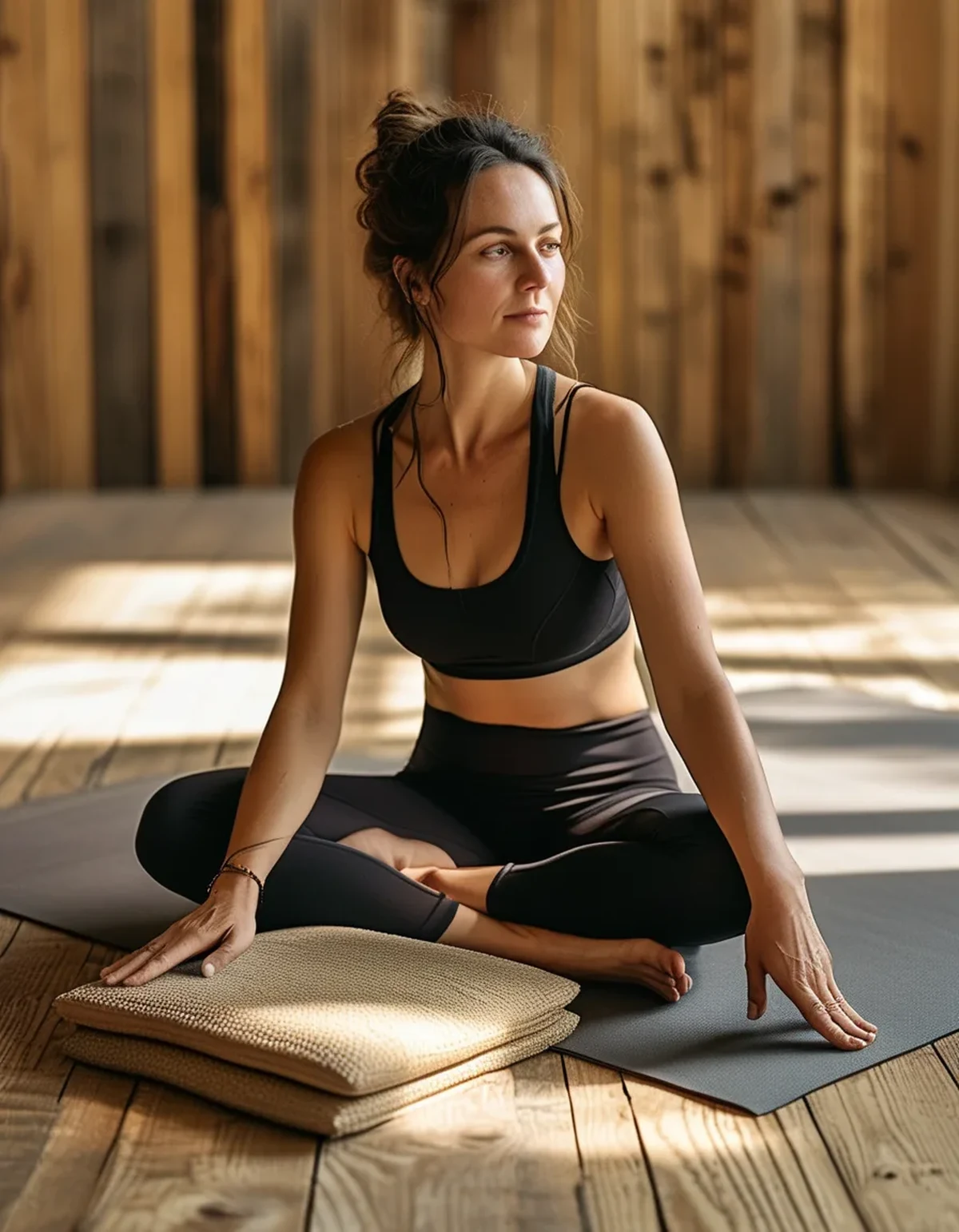
In the first thirty seconds of any supported pose, your muscles are still fresh and quietly doing much of the work. The prop is barely loaded, so the surface underneath it does not matter. You could be on concrete or a duvet and the pose would feel the same.
By the second or third minute, the muscle contribution drops and your weight settles genuinely into the prop. That is when the block starts to sink, when the tilt appears, and when a long hold on a soft mat begins to feel subtly wrong — a slow drift you cannot quite locate.
This is why the setup that felt fine at the start of a five-minute hold can feel unsupported by the end. Nothing moved suddenly; the load simply arrived. If you practise long holds, the firmness of what is under your props matters far more than if you flow.
The fix is simple: for long holds, put the block directly on the floor beside the mat rather than on it.
What Nobody Tells You About Props and Surfaces
Studio floors are the reason your studio practice feels better. Most studios have hard wood or vinyl over a solid subfloor, with thin mats on top. That is close to the ideal environment for props — everything sits where you put it. Your home practice on a plush mat over carpet is a different physical situation, and comparing the two is not fair to either.
Carpet is a bigger variable than the mat. A thick mat on a hard floor is manageable. A thin mat on a deep-pile carpet is not, because the whole system underneath is compressible. If your practice space is carpeted, a hard board or a folded firm blanket under the prop makes more difference than any mat you could buy.
And the detail almost nobody mentions: blocks themselves vary hugely. A foam block compresses under load — sometimes by 2 or 3mm — while cork and wood do not. Stack a compressible block on a compressible mat and the height you carefully chose is largely fictional by the third minute. If you own one cork block and several foam ones, use the cork block for the pose where the height genuinely matters.
FAQ: Props and Mat Thickness Questions, Answered
Should I buy a thinner mat?
Only if standing and balancing work is most of your practice. A better solution for most people is two surfaces: a thin mat or bare floor for standing work, and a thick mat or folded blanket for kneeling and restorative work. That costs less than replacing a mat you otherwise like.
Can I just use a taller block to compensate?
It helps with height but not with tilt, and tilt is the part that changes the pose. If you can, place the prop off the mat onto the floor instead — it solves both at once.
Does this apply to straps too?
Much less. A strap transmits tension between two points and is not resting on the surface, so mat thickness barely affects it. It matters most for blocks, then bolsters, then blankets.
Why does my block slide on a thin mat?
Different problem, same family. Very thin or worn mats have less grip, so a block under load can skate. A textured or cork block, or placing it on the bare floor, usually fixes it.
TL;DR:
- A thick mat lets a loaded block sink and tilt, effectively removing 3 to 5mm of height
- Standing and balancing poses are most affected; restorative poses barely notice
- Soft surfaces damp balance feedback, making supported balance poses feel harder than they are
- The effect appears at the third minute of a hold, not at the start
- For long holds and balances, put the prop on the floor rather than on the mat
If a supported pose has quietly stopped working and you cannot say why, look down before you change anything else. The prop is probably fine. The surface it is standing on is doing something you did not ask it to.
See It in Motion
Seen here: Bootcut Capri Yoga Pants with Pockets — shop similar styles on bubblelime.com
Keep Reading
This article is for general informational and styling purposes only. Fit, sizing, and product availability may vary.