The Wall Is the Best Yoga Prop You Already Own — Here's How to Actually Use It
Quick Answer: The wall is yoga’s most underrated prop — it does five jobs no block can: alignment feedback (your back tells the truth against it), balance scaffolding (fingertip support turns wobbling into training), safe intensity (legs-up-the-wall, supported inversions), depth calibration (wall-assisted stretches with measurable progress), and strength loading (wall planks to wall handstand progressions). Every home has one; almost nobody’s practice uses it.
Yogis will spend forty dollars on cork blocks while ignoring the infinitely rigid, perfectly vertical, completely free prop holding up their ceiling. The wall isn’t the beginner’s crutch it gets treated as — advanced practices use it constantly, for reasons that make every level of practice better.
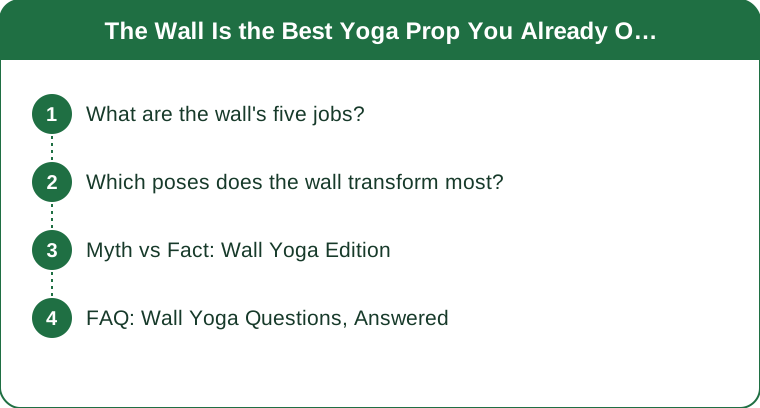
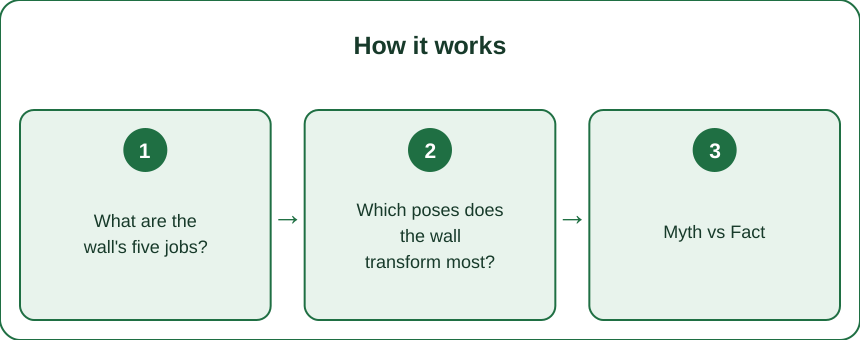
What are the wall’s five jobs?
1. The truth-teller: stand with heels, hips, upper back, and head against it — the wall reports your posture without flattery (that gap behind your lower back, that head that doesn’t reach). In poses, a wall-touch calibrates alignment your proprioception fudges: mountain pose, chair pose with back support, wall-guided warrior alignment.
2. The balance scaffold: a fingertip on the wall converts falling-out-of-tree-pose into actually-training-tree-pose — you keep the balance challenge while removing the crash-out resets. Progression is built in: full hand → fingertip → hovering near → free.
3. The safety rail for intensity: legs-up-the-wall (the restorative crown jewel — zero effort, deeply downshifting), supported shoulder stand variants, and wall-assisted inversions that let you explore upside-down with an exit strategy.
4. The depth calibrator: wall-assisted hamstring and hip stretches let you fine-tune intensity by distance (an inch closer = one notch deeper) — a precision no free-floating stretch offers, with visible week-over-week progress.
5. The strength loader: wall planks and wall push-ups scale pressure work to any level, wall sits build the standing-pose engine, and the wall-walk handstand progression is the respected route to inversions — used by absolute beginners and hand-balancers alike.
Which poses does the wall transform most?
Legs-up-the-wall (Viparita Karani): hips a hand-width from the wall, legs resting up it, 5-15 minutes — the highest relaxation-per-effort pose in all of yoga, and the standard wind-down for tired legs, travel days, and racing minds.
Tree and half-moon with wall backup: half-moon along the wall (back body lightly touching) is a revelation — the wall handles the fall-risk while you actually open the pose; most people’s best-aligned half-moon ever happens there.
Downward dog at the wall (hands on wall, L-shape): takes wrist load and inversion pressure out entirely while teaching the hip-hinge and spine-lengthening the floor version obscures — ideal for wrist issues, beginners, and office-break resets in regular clothes.
Wall-supported standing forward folds and hamstring stretches: hips against the wall for folds (weight anchored, hamstrings isolated), or the lying strap-alternative — one leg up the wall’s corner edge, adjusting depth by scoot distance.
Chest-and-shoulder openers: forearm on the wall, gentle turn away — the doorway stretch’s calibrated cousin, with the same inch-by-inch dosing as everything else wall-based.
The pattern: the wall doesn’t make poses easier so much as it makes them specific — removing the variable you’re not training (balance, fall-fear, load) so the one you are training gets the full rep.
Myth vs Fact: Wall Yoga Edition
Myth: The wall is for beginners who can’t do the real pose. Fact: Teacher trainings drill alignment at the wall, hand-balancers live on wall progressions, and Iyengar tradition — the lineage most obsessed with precision — built half its method on wall work. The wall is where poses get refined, at every level.
Myth: Using the wall for balance poses prevents you from ever balancing freely. Fact: Backwards — crash-and-reset teaches falling; scaffolded holds teach balancing (longer time under challenge per session, progressive support reduction). The fingertip-to-free pipeline is standard motor-learning, and it works faster than pride does.
Myth: Legs-up-the-wall is just lying down and barely counts. Fact: It counts precisely because it’s barely anything — a genuinely accessible downshift for the nervous system, tired legs, and busy heads, delivering the restorative benefits people skip harder practices to avoid missing. ‘Barely anything’ is the feature. (Certain conditions — glaucoma, some cardiovascular situations, late pregnancy — warrant professional guidance before inverted or legs-elevated positions. This is general information, not medical advice.)
The meta-point: prop stigma is the actual obstacle — the practitioners progressing fastest are usually the ones using the most support, most precisely.
FAQ: Wall Yoga Questions, Answered
How much wall space do I actually need?
A door-width of clear wall handles nearly everything — legs-up, L-shaped dog, balance backup, stretching. The full wall-walk handstand progression wants a bit more clearance and a non-slip floor. Rearranging one bookshelf is the entire equipment investment.
Can wall work replace my blocks and straps?
Substantially: the wall covers the strap’s hamstring jobs (leg-up-the-wall stretches) and many block jobs (support, calibration). Blocks still win for under-hand/under-hip portable support mid-flow. Ideal budget order for a home practice: wall (free) → two blocks → strap.
What’s the best 10-minute wall-only session?
A reliable circuit: L-shaped downward dog (2 min) → wall-supported forward fold (1 min) → half-moon along the wall (1 min/side) → wall chest opener (1 min/side) → legs-up-the-wall (4 min). Alignment, balance, opening, and downshift — the wall’s whole résumé in one break.
TL;DR:
- The wall does five jobs: truth-telling alignment, balance scaffolding, safe intensity, calibrated stretch depth, and strength loading
- Transformation list: legs-up-the-wall, wall half-moon, L-shaped dog, anchored folds, doorway-style openers
- Support isn’t the beginner track — it’s how poses get refined at every level; the fingertip-to-free pipeline beats crash-and-reset
- One door-width of clear wall is the entire equipment requirement
The most versatile prop in yoga has been holding up your ceiling rent-free — put it to work. This is general information, not medical advice.
See It in Motion
Seen here: Super High Waist Embossed Yoga Leggings with Inner Pocket — shop it on bubblelime.com
Keep Reading
This article is for general informational and styling purposes only. Fit, sizing, and product availability may vary.