What a Yoga Strap Does That Reaching Harder Never Will
Quick Answer: A yoga strap works by extending your arms so you can hold a position at your actual range with relaxed shoulders and easy breath. Without it, reaching for a foot you cannot comfortably grasp turns the whole pose into a gripping contest — shoulders hike, back rounds, breath shortens, and the nervous system reads all that strain as a reason to guard the very muscle you came to release. The strap removes the reaching so the target tissue can actually let go.
It is the two-dollar difference between performing a stretch and receiving one.
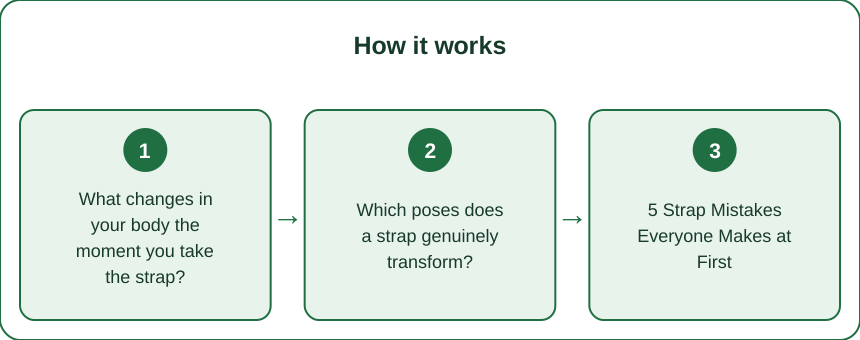
What changes in your body the moment you take the strap?
Almost everything upstream of the stretch.
Try the experiment in a seated forward fold. Reaching hard for your feet, notice the inventory: shoulders pulled up toward your ears, upper back rounding to buy a few inches, jaw set, breath shallow because your torso is busy being a crane. The hamstrings are technically stretching, but they are stretching inside a body that is working, and working tissue does not release well.
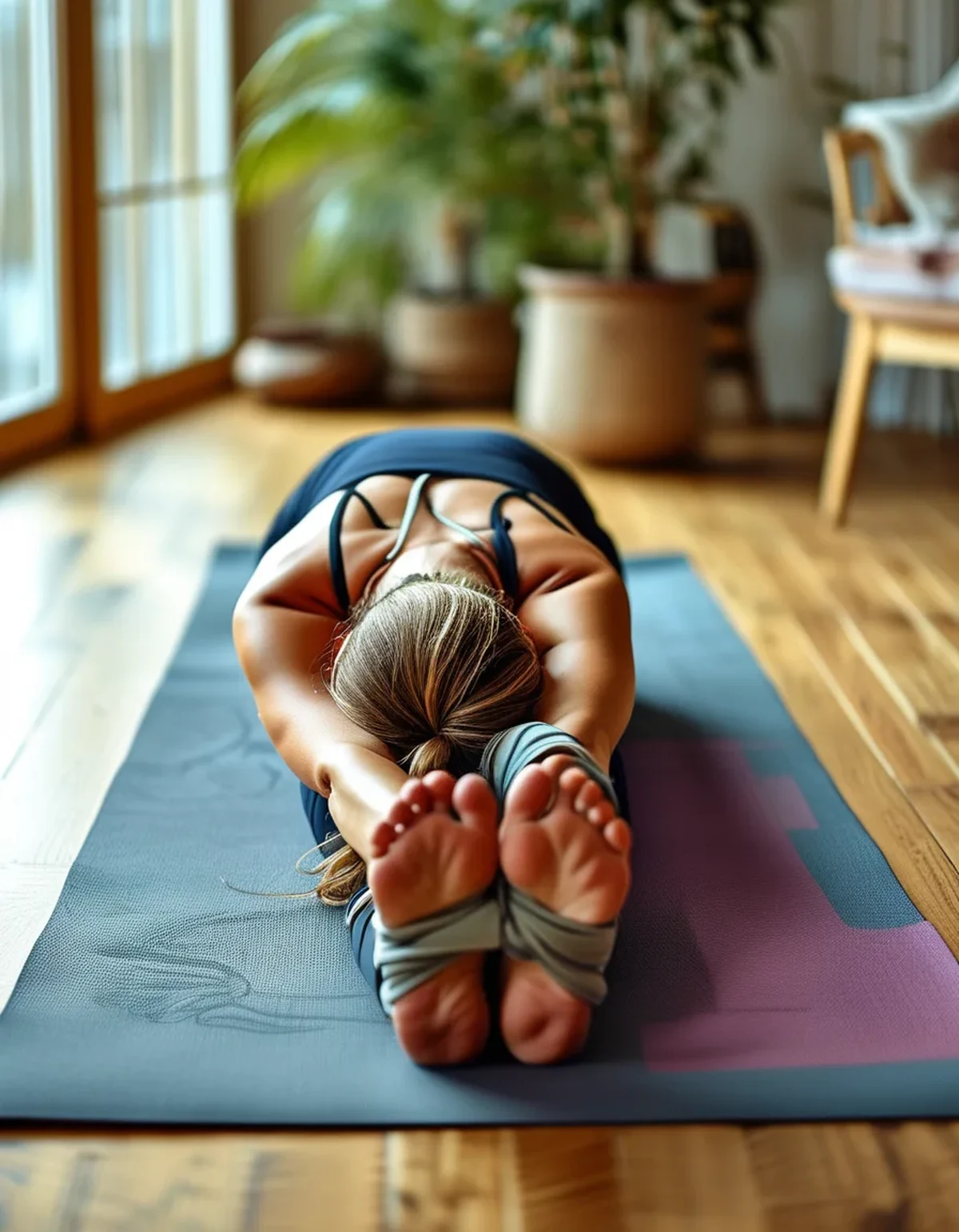
Now loop a strap around the feet and hold it where your arms reach easily. The shoulders drop and pack down their sockets. The spine can stay long instead of rounding, which means the fold starts happening at the hips — where you wanted it — rather than in the lower back. The breath comes back, because nothing is hauling on it.
Effort is not neutral in stretching. A stretch performed under global tension teaches the nervous system that this range is a place of strain; the protective response is to guard it. The same range visited with soft shoulders and slow breath gets a different verdict, and the guarding eases session by session.
That is the strap’s real mechanism. It is not helping you reach further. It is deleting the cost of reaching at all, so that one hundred percent of the position’s attention lands on the tissue you aimed it at. The pose gets quieter, and quieter poses change bodies faster than impressive ones.
Which poses does a strap genuinely transform?
Four families, each for a different reason.
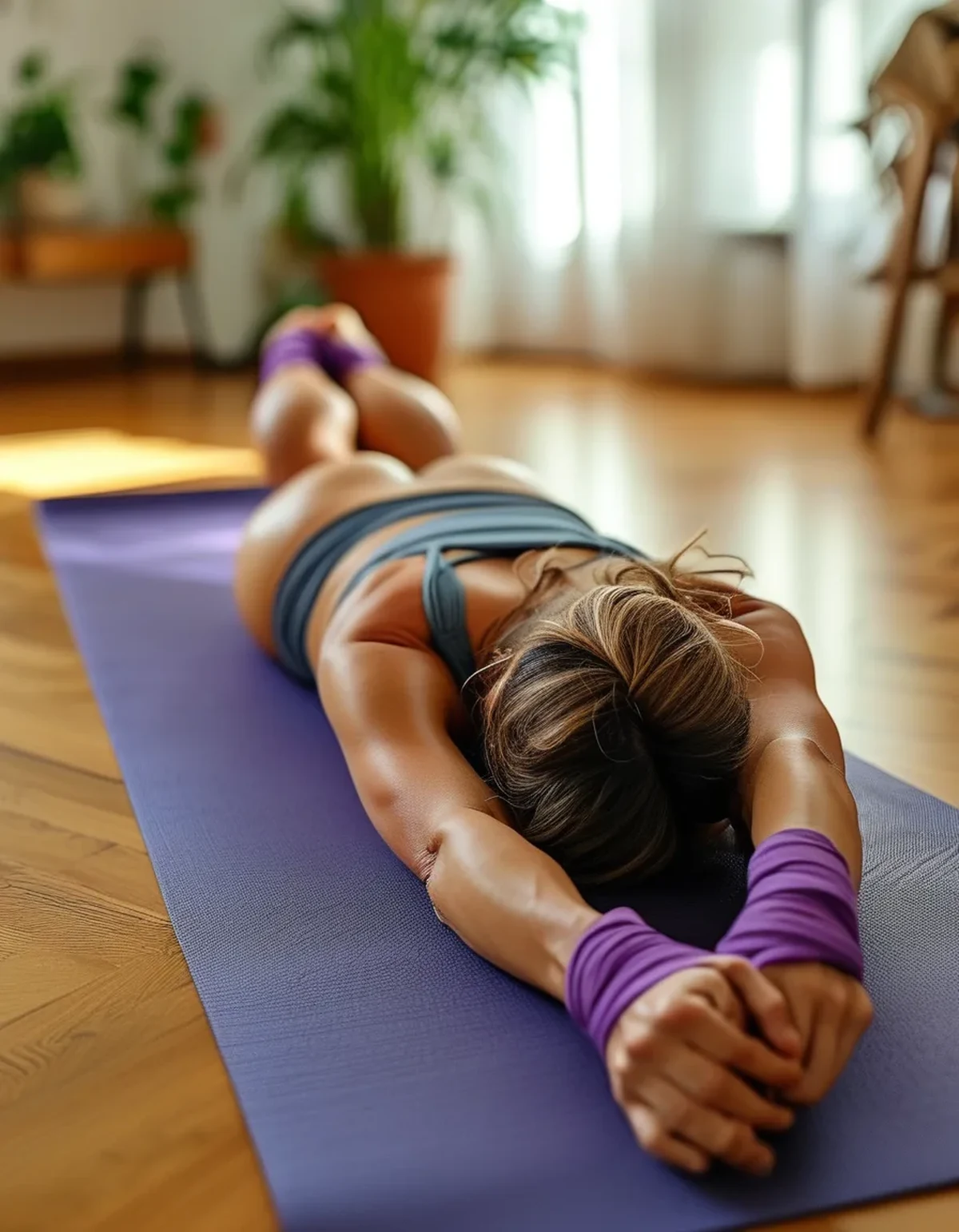
Reclined leg stretches. Lying on your back with one leg raised, strap around the arch: this is the gold-standard hamstring position precisely because the floor holds your spine and pelvis honest while the strap holds the leg. No propped-up neck, no lifted hips bargaining for range. Three minutes a side here outworks ten of strained standing folds.
Seated folds. As above — the strap converts them from lower-back events into hip events. The cue that unlocks it: pull lightly on the strap to lift the chest, then fold from the crease of the hips, moving one inch per exhale.
Shoulder and chest openers. Hold the strap wider than shoulder width and float it overhead and behind; the fixed distance between hands gives the shoulders a track to travel along. And in the classic behind-the-back clasp — one hand reaching down the spine, the other reaching up — the strap dangles from the top hand so the bottom hand can climb it, letting you work at whatever gap your shoulders actually have today.
Balancing binds. Standing big-toe holds and dancer pose stop being hamstring-versus-balance negotiations when a strap loops the foot; you get to train the balance and the alignment while the flexibility catches up on its own schedule.
The pattern across all four: the strap holds a distance so your joints do not have to force one. Anywhere a pose asks two body parts to connect before they can, the strap is the adapter.
5 Strap Mistakes Everyone Makes at First
Setting the length mid-pose. Fumbling with the buckle while folded in half converts a restful hold into a wrestling match. Set your length before you enter — most people need only two or three settings across a whole practice, and they are learnable in one session.
Pulling instead of holding. The strap is a tether, not a winch. Hauling on it to crank yourself deeper reinstalls the exact strain the strap exists to remove. The pull should be light enough that your shoulders stay heavy and your breath stays slow; depth arrives on the exhales, unforced.
Wrapping it around the palm for grip. A strap cinched around the hand cuts circulation inside a minute and puts the wrist in a cranky angle. Drape it over the fingers and let friction do the work; if you need a death grip, the setting is too aggressive.
Using it to force binds for the photo. Straps make ambitious binds accessible, which is the feature and the trap. Connecting hands behind your back through a strap at a respectful distance is practice; yanking the hands toward each other because touching fingers feels like winning is how shoulders get tweaked in quiet rooms.
Holding your breath while holding the strap. The strap frees the breath — that is most of its job — so a held breath is the signal you have smuggled effort back in somewhere. Every strap hold has the same soundtrack: slow exhales you can hear.
All five mistakes are the same mistake wearing different clothes: treating the strap as a tool for getting further instead of a tool for being somewhere well.
How do you choose one and build the habit at home?
The buying decision takes two minutes; the habit is the actual project.
Length: six feet serves most bodies and most poses; go eight feet if you are tall, broad-shouldered, or want generous loops for reclined work. Longer is never a problem — you just hold it shorter.
Material: cotton has the friendliest grip and a soft hand; nylon slides more, which you will notice exactly when sweat arrives. Buckle: a metal D-ring holds a loop most securely; plastic cinch buckles are lighter and quieter. Any of them outlives you — this is a one-time, single-digit purchase.
The substitutes and where they fail: a bathrobe tie works surprisingly well; a towel works for short holds but is bulky in loops; a stretchy resistance band specifically does not work for this job — the give lets your nervous system keep negotiating, and the whole point of a strap is a distance that stays put.
The ten-minute evening sequence that makes it stick: reclined leg stretch, three minutes each side; seated fold with strap, two minutes; wide-grip shoulder pass-overs, one minute; behind-the-back climb, one minute per arm. Wear whatever lets the hips move — leggings or yoga pants with real stretch, nothing with a waistband that argues — and do it on the living room floor while the kettle is on. Frequency beats duration here by a mile: ten minutes most evenings will change your forward fold by October in a way that one long Sunday session never will.
Gentle stretching is broadly safe, but numbness, tingling, or joint pain are stop signs, not sensations to breathe through.
FAQ: Yoga Strap Questions, Answered
Is a strap just a crutch that delays real flexibility?
The opposite, mechanically: range gained under strain gets guarded again, while range visited calmly gets kept. As your reach improves, the strap naturally shortens out of poses on its own — nobody has to wean you.
Strap or towel — does the difference matter?
For an occasional hold, a towel is fine. For a daily practice, the strap earns its few dollars with loops that stay set, a flat profile that does not bunch, and enough length for reclined and shoulder work a towel cannot cover.
Can desk workers use it for shoulders specifically?
It is arguably the best desk-recovery tool there is: wide-grip pass-overs and the behind-the-back climb, two minutes at the end of the day, directly counter the keyboard shape. Keep a strap on the chair arm and the habit installs itself.
How long should I hold strap-assisted stretches?
Long enough for the release response — sixty seconds as a floor, two to three minutes for the reclined positions, always at an intensity where breath stays conversational. If you cannot imagine another thirty seconds, you are too deep.
TL;DR:
- A strap extends your arms so a stretch happens with relaxed shoulders and easy breath — deleting the strain that makes the nervous system guard your range.
- It transforms four families: reclined leg stretches, seated folds, shoulder openers, and balancing binds.
- Hold it, do not haul on it; set length before the pose; never wrap it around your palm.
- Six-foot cotton with a D-ring is the default buy; a nightly ten-minute sequence beats a weekly marathon.
Run the two-version experiment tonight — the forward fold with and without the strap. Your shoulders will explain the whole article in thirty seconds.
See It in Motion
Seen here: Super High Waist Embossed Yoga Leggings with Inner Pocket — shop it on bubblelime.com
Keep Reading
This article is for general informational and styling purposes only. Fit, sizing, and product availability may vary.