Why a Block Under Your Hand Changes a Pose More Than One Under Your Hip
Quick Answer: A prop under a load-bearing contact point changes the geometry of the entire pose — joint angles, muscle lengths, where the effort lands. A prop used for padding or support changes sensation without changing structure. Both are legitimate, but only one alters what the pose is training.
Two people in the same pose, both using a block, getting completely different things out of it. The block isn’t the variable. Where it sits in the load path is.
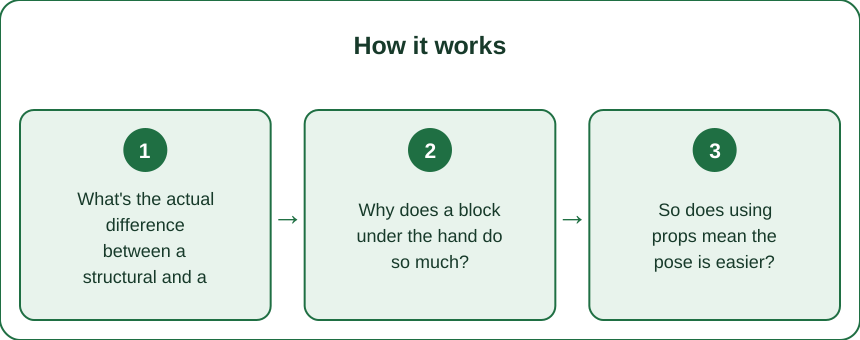
What’s the actual difference between a structural and a comfort prop?
A structural prop sits in the load path — under a hand, under a foot, between the thighs when you’re actively pressing into it. It changes the distances your body has to bridge, which changes joint angles up the entire chain.
A comfort prop sits outside the load path — a blanket under a knee, a bolster you’re resting on passively. It changes sensation and sustainability. Both are useful, but only the structural prop changes what the pose is actually asking of you, and confusing the two is why prop advice so often seems contradictory.
Why does a block under the hand do so much?
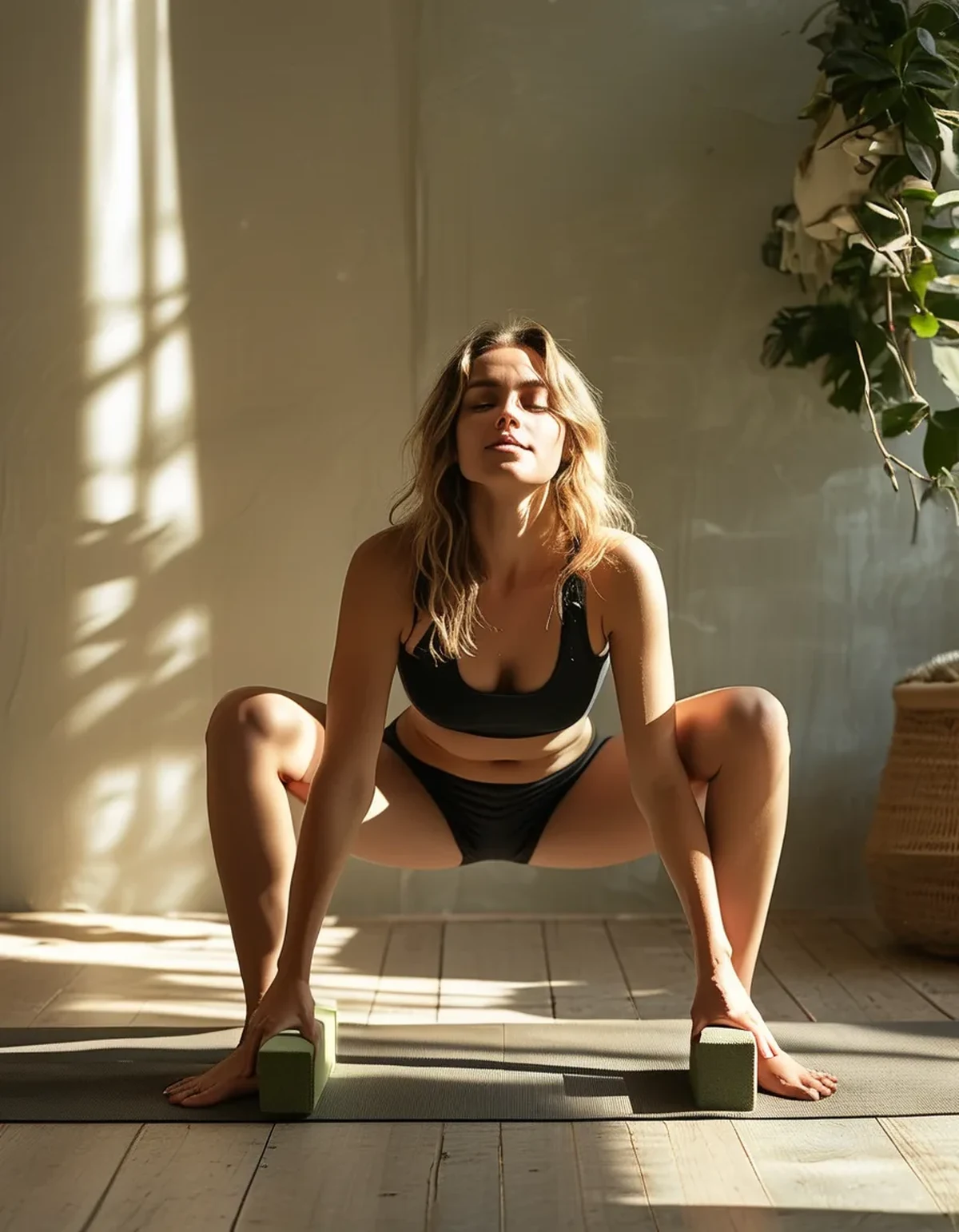
In a standing pose, the hand’s ground contact point determines how far the torso has to travel. Raising that point by even a few inches reduces the required range at the hip and spine substantially.
That matters because a pose performed beyond available range is usually compensating somewhere — most commonly by rounding the spine or rotating the pelvis. Bringing the floor up lets the pose happen at the joints it was designed for, which is a change in what’s being trained, not a reduction in difficulty. A block at its tallest setting in a triangle-family pose can be the difference between training hip mobility and training spinal compensation.
So does using props mean the pose is easier?
Frequently the opposite. Props that improve alignment often increase the muscular demand, because the effort moves from passive tissue hanging into position to active muscle holding position.
A block between the thighs in a bridge is the clearest example: actively pressing into it recruits adductors and changes pelvic control, making the pose harder while looking identical from outside. A strap in a seated forward fold, used to maintain a long spine, similarly increases posterior chain work compared to rounding forward without it.
Myth vs Fact: Yoga Props
Myth: Props are for beginners. Fact: Iyengar-lineage practice, where props were systematized, uses them at every level. Advanced practice tends to use more props, not fewer, because precision demands them.
Myth: Using a block means you’ll never progress past it. Fact: Practicing correct joint mechanics with a prop builds the mobility that eventually removes the need. Practicing compensated mechanics without one builds the compensation.
Myth: Two blocks are for people who can’t do one. Fact: Two blocks are standard equipment in most well-equipped practices, and many poses specifically call for a matched pair.
Myth: A folded blanket and a block are interchangeable. Fact: They behave completely differently under load — a blanket compresses and a block doesn’t, which makes blankets a poor choice under a load-bearing hand.
How do you decide where a prop should go?
Ask a single question: what is preventing the shape from happening at the right joints?
If the answer is distance — the floor is too far away — the prop belongs at the contact point that can’t reach. If the answer is that a joint can’t hold a position long enough, the prop belongs where it supports that position. If the answer is that something hurts, the prop belongs under the painful contact and the pose probably needs modifying beyond props.
Concretely: hand can’t reach the floor without rounding, block under hand. Knees hover in a seated pose, block or bolster under knees. Hip flexors cramp in a lunge, blanket under the back knee. Each answer follows directly from the diagnosis, which is why the question matters more than memorizing prop configurations.
FAQ: Yoga Prop Questions, Answered
How many blocks should I actually own?
Two is the practical standard — a large number of poses use a matched pair, and having only one forces asymmetric improvisation.
Cork or foam?
Cork is denser, more stable under a load-bearing hand, and doesn’t compress. Foam is lighter and kinder under bony contact points. Owning one of each covers both roles well.
Is a strap really necessary if I have blocks?
A strap does something blocks can’t — it extends reach while letting you maintain spinal length. For seated forward folds and shoulder work specifically, it’s the more useful tool.
TL;DR:
- Props in the load path change joint angles; props outside it change comfort
- A block under the hand can change what a pose trains, not just how hard it feels
- Well-placed props often increase muscular demand rather than reducing it
- Diagnose what’s preventing the shape, then place the prop at that specific limit
- Two blocks, one strap, one blanket covers nearly everything
Prop placement is a diagnostic decision, not a difficulty setting. Ask what’s actually blocking the shape and the placement answers itself.
See It in Motion
Seen here: High Waist Bootcut Yoga Pants with Pockets — shop it on bubblelime.com
Keep Reading
This article is for general informational and styling purposes only. Fit, sizing, and product availability may vary.