Why Props Change Your Breathing Before They Change the Pose
Quick Answer: When a pose is at the edge of your range, your body braces - the ribs stiffen, the diaphragm has less room to move, and breathing becomes shallow and effortful. A prop reduces the range demand just enough that the bracing stops, which restores diaphragm movement and full rib expansion. The improved shape you eventually get comes from that: a body that is no longer defending itself can actually release. Breathing is the first thing props fix, and everything else follows.
Which means the right prop height is the one where your breath returns - not the one that looks most impressive.
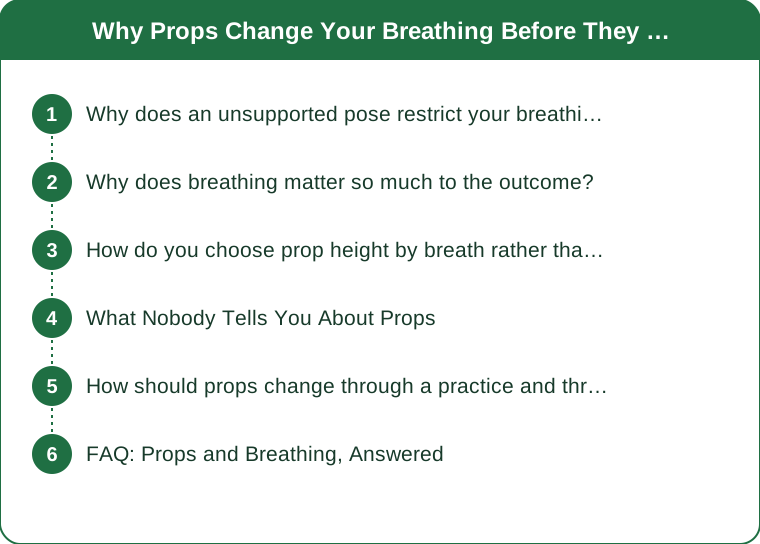
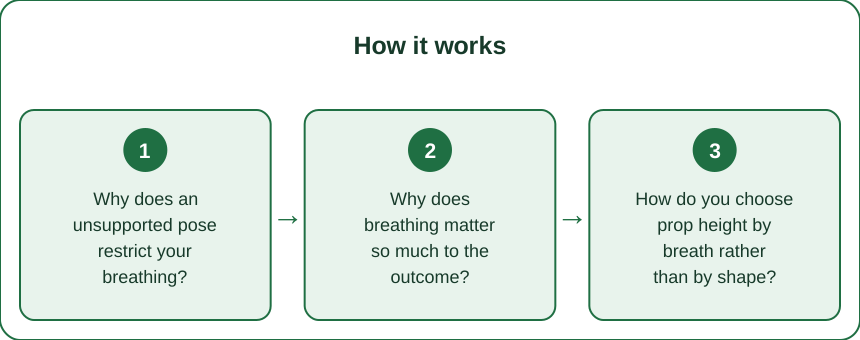
Why does an unsupported pose restrict your breathing?
Three mechanisms, and they reinforce each other.
Tissue at end range triggers protective muscle activity. When a muscle is stretched close to its limit, the nervous system responds with a low-level contraction to protect it. That guarding is not limited to the target muscle - it spreads through the trunk, and a braced trunk is a stiff ribcage.
Effort recruits accessory breathing muscles. When holding a position takes real work, you start breathing with your neck and upper chest rather than your diaphragm. This is shallower, less efficient, and it is what people describe as feeling breathless in a pose that involves no cardiovascular effort at all.
And the shape itself can compress the ribcage. Deep forward folds compress the front of the abdomen and limit how far the diaphragm can descend. Twists restrict rotation of the ribs on one side. The pose is mechanically limiting your breath before any effort is involved.
Put together, an unsupported end-range pose produces the exact opposite of what the pose is for. You are asking the body to release while giving it every reason to guard.
A prop interrupts that loop. Reduce the range demand slightly and the protective contraction eases, the trunk softens, and the diaphragm gets its excursion back - usually within two or three breaths, which is fast enough to feel clearly.
Why does breathing matter so much to the outcome?
Because the nervous system decides how much range you get, and breath is the most direct input you have.
Range of motion is substantially neurally regulated. How far a joint moves in a stretch is limited less by tissue length than by how much movement your nervous system will permit before it protects the tissue. That threshold moves.
Slow, full exhalation shifts the balance toward the parasympathetic side - the state associated with reduced muscle guarding. The threshold rises, and the same pose becomes accessible without more force.
Held breath does the opposite. Breath-holding increases intra-abdominal pressure and trunk stiffness - useful when lifting something heavy, counterproductive when trying to release.
Which is why the standard advice to breathe into the stretch is mechanically true rather than merely poetic. The breath is not decoration on the stretch; it is one of the variables determining how much stretch you get.
And it explains the timing pattern people notice: the release in a supported hold typically arrives at the second or third minute, after several slow breath cycles, rather than immediately. Props are what make holding that long possible - it is very hard to stay in an unsupported end-range pose for three minutes without bracing.
How do you choose prop height by breath rather than by shape?
A simple test that replaces a lot of guesswork.
Set up the pose with the prop where you think it belongs. Take three slow breaths.
Ask one question: can you exhale completely and slowly? Not whether the stretch is strong. Whether the breath is full and unhurried.
If the breath is short, held, or effortful, add support. A higher block, a folded blanket, a bolster, a wall. The correct height is the highest one at which you still feel the pose - which is usually higher than people choose.
If the breath is completely effortless and the pose registers as nothing, reduce support - though be slow to do this, because a supported hold that feels easy is often doing more than it appears over three minutes.
Re-check at the two-minute mark. This is the step almost everyone skips. Tissue responds during the hold, and the height that was right at 30 seconds is often too high at two minutes. Adjusting mid-pose is not a failure of the initial setup; it is the pose working.
And expect the answer to change day to day. Sleep, hydration, time of day, temperature, training load, and cycle phase all move your available range. The same block height genuinely is right one day and wrong the next, and choosing by breath rather than by memory is what accommodates that.
What Nobody Tells You About Props
Props usually make a pose harder to escape, not easier to do. A supported hold that you can sustain for four minutes does far more than an unsupported version you abandon at forty seconds. Duration is the variable props buy you, and duration is what changes tissue.
Setting up props before you enter the pose matters more than adjusting once inside. Fumbling for a block mid-pose interrupts the breath and reintroduces the guarding you were trying to remove. Set the room up first.
More props is not more supported. A stack of props that leaves you unstable produces bracing of a different kind. Stability is the actual goal - one well-placed prop beats three precarious ones.
The prop is a variable, not a fixture. Blocks have three heights for a reason, and most people use the same one every time out of habit. Turning the block is free.
Restorative and stretching props do different jobs. In restorative work the aim is complete support - you should feel no stretch at all - so the nervous system fully downshifts. In stretching work you want a small amount of sensation. Using restorative setups for stretching, or vice versa, is a common reason a practice feels unproductive.
And a blanket is more versatile than any block. It folds to any height, it conforms to the body, and it adds warmth - which matters, because a cold body guards more. As the season turns and studios and living rooms get cooler, the same practice genuinely needs more support than it did in July, and a blanket is the cheapest way to supply it.
The one that surprises people: using a prop often produces more sensation, not less. Better position and less guarding means the target tissue actually receives the stretch rather than the body distributing it into compensations.
How should props change through a practice and through the seasons?
Two adjustments people rarely make.
Through a single practice: reduce support as you warm. The block height that is right in the first five minutes is often too high by minute thirty. Starting supported and progressively reducing is a better sequence than starting unsupported and adding props once you have already braced.
Through the year: add support as it gets colder. Muscle and connective tissue are less compliant at lower temperatures. A cooler room genuinely reduces your available range, and the appropriate response is more support and longer warm-ups rather than more force.
Time of day matters too. Spinal discs are more hydrated in the morning, so some people find spinal flexion less comfortable early and prefer more support then. Evening practice frequently needs less.
And after training, support more. Fatigued and sore muscles guard more readily. A post-training practice with props at a higher setting is doing appropriate work, not less work.
A practical structure that accommodates all of this: keep two blocks and a folded blanket within arm’s reach for every practice, decide the height by the breath test each time, and give yourself permission to change it mid-hold.
And one thing that is not about props at all: if the breath will not settle no matter how much support you add, the issue is usually not the pose. Fatigue, stress, illness, or a full stomach all make breath-led practice difficult, and the correct response is a shorter, gentler session rather than more props.
This is general information, not medical advice. If you have a recent injury, joint hypermobility, osteoporosis, high blood pressure, glaucoma, or you are pregnant, some positions and supports need specific modification - work with a qualified teacher who can see you, and tell them about the condition before class rather than after.
FAQ: Props and Breathing, Answered
How do I know if my block is at the right height?
Take three slow breaths in the pose. If you can exhale completely and unhurriedly while still feeling the pose, the height is right. Short or effortful breathing means add support.
Why do I feel more sensation with a prop, not less?
Because better positioning and reduced guarding means the target tissue actually receives the stretch, rather than the body spreading it into compensations elsewhere. More support frequently means more targeted sensation.
Should I remove props as I get more flexible?
Sometimes, but not automatically. Props buy duration, and duration is what changes tissue. A supported four-minute hold generally does more than an unsupported forty-second one, regardless of how flexible you are.
Do I need to change props during a single practice?
Yes, usually. Tissue responds during a hold and across a session, so the height that was right at 30 seconds is often too high at two minutes, and too high again by the end of the practice.
Why does the same pose feel different day to day?
Sleep, hydration, temperature, time of day, training load, and cycle phase all shift your available range. Choosing prop height by breath rather than by memory is what accommodates that variation.
Does room temperature really matter?
More than people expect. Cooler tissue is less compliant and the body guards more, so the same practice needs more support in a cool room than it did in summer. A blanket adds both height and warmth.
TL;DR:
- An end-range pose triggers protective muscle guarding, which stiffens the ribcage and pushes you into shallow, accessory breathing.
- Props reduce the range demand just enough that the guarding stops and the diaphragm gets its movement back.
- Range of motion is largely neurally regulated, and slow full exhalation raises the threshold at which your nervous system permits movement.
- Choose prop height by a three-breath test: the correct height is the highest one at which you can still feel the pose and exhale completely.
- Re-check at two minutes - tissue responds during the hold and the right height changes.
- Props buy duration, and duration is what changes tissue. A four-minute supported hold beats a forty-second unsupported one.
- Add support as the room gets cooler, after training, and early in the morning. A blanket does what a block cannot: it adds height and warmth.
If the breath will not settle no matter how much you support the pose, the answer is a shorter session - not more props.
This is general information, not medical advice.
See It in Motion
Seen here: High Waist Bootcut Yoga Pants — shop it on bubblelime.com
Keep Reading
This article is for general informational and styling purposes only. Fit, sizing, and product availability may vary.