Why Props Feel Unnecessary Until the Third Minute of a Hold
Quick Answer: In a short hold, active muscle tension does the supporting work and you barely notice the effort. In a long hold, muscles fatigue and the load transfers to passive tissue — joints, ligaments, fascia — which is where discomfort appears. Props take over the supporting job so the pose stays sustainable past the point where your muscles quit.
You skip the block because the pose feels perfectly fine without it. And it is fine, for ninety seconds. Then something at the front of your hip starts talking, your breath shortens, and you spend the remaining time negotiating instead of resting.
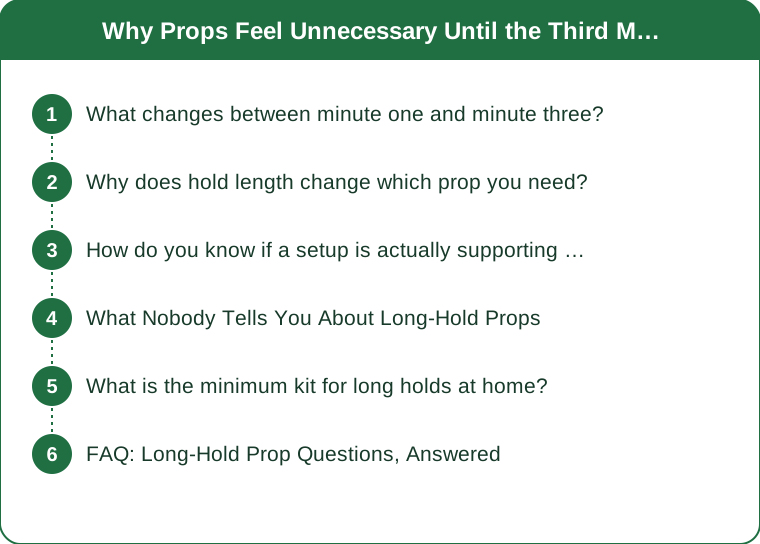
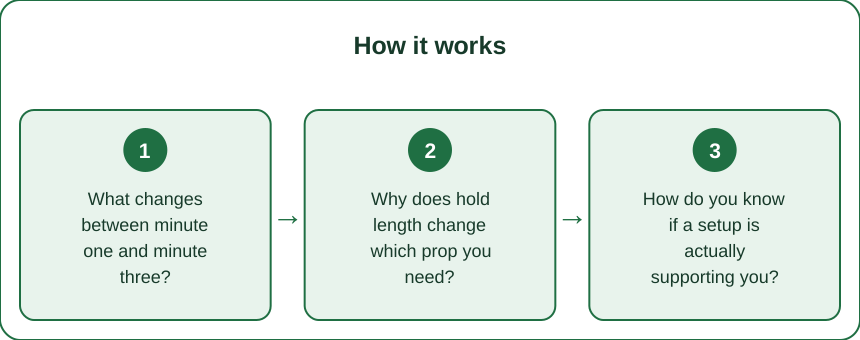
What changes between minute one and minute three?
Who is doing the work.
When you first enter a pose, your muscles are fresh and they hold you in position actively. That active support is cheap at first — it costs a little energy and nothing else — which is why the unpropped version feels completely fine at the start.
As the hold continues, those stabilizing muscles fatigue, and the load has to go somewhere. It transfers to the passive structures: joint capsules, ligaments, and connective tissue. Those structures can bear load, but they signal differently. Instead of the honest burn of a working muscle, you get a vaguer, more insistent ache that is hard to locate.
That is the moment most people start fidgeting. It is also the moment where the pose stops doing what it was meant to do, because you cannot down-regulate your nervous system while you are managing discomfort. Restorative work depends on the body concluding that nothing needs attention, and a hip that is quietly complaining is attention.
A prop simply prevents that handover. Support the shape externally and your muscles never have to fatigue, so the transfer never happens.
Why does hold length change which prop you need?
Because short holds and long holds have different failure points.
A rough guide:
- Under 1 minute: props mainly serve alignment. A block under the hand in a standing pose brings the floor up so your spine can stay long. Comfort is not yet the issue
- 1 to 3 minutes: props start serving endurance. This is where a strap for a bound position or a blanket under the knees stops the small stabilizers from having to work continuously
- 3 to 10 minutes: props serve the nervous system. Now the goal is full passive support, and anything you are actively holding will eventually become the thing you notice
- Over 10 minutes: props serve circulation and joint comfort. Even a well-supported position can produce pressure points, and small adjustments in padding become the difference between rest and restlessness
This is why the same pose needs a different setup in a vinyasa class and a restorative one. The pose has not changed; the duration has, and duration determines which tissue is carrying you.
How do you know if a setup is actually supporting you?
Three checks, all of which take about ten seconds.
The breath check. In a genuinely supported position, your breath should be able to lengthen and slow within thirty seconds. If your breath stays short or you find yourself holding it, something is still working that should not be.
The exhale test. Take a full exhale and let everything go completely. If any part of you drops further, that part was being held. Add support there.
The two-minute rule. Set the shape, wait two minutes, and reassess before deciding it is right. A setup that feels perfect on arrival and wrong at minute three was never right — it was just early. Conversely, a setup that feels slightly over-supported at first is often exactly correct by minute five.
That last one is the most useful and the least intuitive. Most people build their setup based on the first ten seconds, which is precisely the window in which the setup does not matter yet.
What Nobody Tells You About Long-Hold Props
Over-support is the safer error. A pose that is too well supported is still restful; a pose that is under-supported is not a pose at all after three minutes. When in doubt, add the blanket.
The head is the most under-propped part of the body. People support hips and knees thoroughly and leave the head tipped back or dropped forward. Neck position strongly influences whether the nervous system settles, and a folded blanket under the head fixes more restlessness than any other single addition.
Props get warmer and softer as you use them. A bolster compresses over a long hold, so a setup that was level at the start can be tilted by minute eight. If a long hold consistently goes wrong at the same point, this is often why.
Cold rooms need more support, not less. Muscle tissue is less compliant when cool, so the same setup produces more tension. As studios and home practice spaces cool down this fall, expect to want slightly more height than you did in July — and a blanket over you rather than only under you.
Symmetry matters more in long holds. A one-inch difference between sides is invisible in a 30-second hold and becomes the entire experience of a 10-minute one.
What is the minimum kit for long holds at home?
Less than a studio has, and most of it is already in your house.
- Two firm blankets. The most versatile item by a distance. Folded, rolled, stacked, or draped, they replace most other props. Wool or dense cotton — a fluffy fleece throw compresses to nothing and is useless as support
- One bolster, or a firm couch cushion. For chest opening, supported forward folds, and under-knee support in reclined poses
- Two blocks. Height for hands, support under a thigh, or spacers between knees. Two behave completely differently from one
- A strap, or a bathrobe belt. Extends your reach so a shoulder does not have to hold a position for five minutes
- A wall. Free, and the most underused prop in existence for long holds
One addition worth making as the seasons turn: an extra blanket for covering rather than supporting. Body temperature drops measurably during long stillness, and a cooling body will not stay relaxed. This is the single most common reason home restorative practice feels less effective than a studio class, and it costs nothing to fix.
FAQ: Long-Hold Prop Questions, Answered
Am I getting less out of a pose if I use more props?
For long holds, generally the opposite. The goal of a supported hold is duration and nervous-system down-regulation, and both improve when your muscles are not working. Effort is the currency of active practice, not restorative practice.
How do I know when to reduce support?
When the propped version stops producing any sensation at all across a full hold, and your breath stays easy the entire time. That is a genuine signal to lower the height slightly. It is a slower process than most people expect — months, not weeks.
Why does the same setup work one day and not the next?
Tissue compliance varies considerably with temperature, hydration, time of day, sleep, and menstrual cycle phase. A block height that was right on Tuesday can be wrong on Thursday for reasons that have nothing to do with progress. Reset the setup each session rather than assuming last time’s numbers.
TL;DR:
- Short holds are supported by muscle; long holds hand the load to passive tissue, which is where discomfort starts
- Match the prop to the duration — alignment under a minute, endurance at 1 to 3, full passive support beyond that
- Test with the breath check, the full-exhale drop, and reassessment at the two-minute mark
- Over-support beats under-support, the head is the most neglected area, and a covering blanket matters as rooms cool
The reason the prop feels unnecessary is that you are judging it in the only window where it genuinely is. Set up for minute five, not minute one.
See It in Motion
Seen here: Racerback Tank Top - White — shop similar styles on bubblelime.com
Keep Reading
This article is for general informational and styling purposes only. Fit, sizing, and product availability may vary.