Why the Same Block Height Works One Day and Not the Next
Quick Answer: Your available range of motion swings meaningfully across a single day and between days, driven by temperature, hydration, sleep, time since waking, and what you did yesterday. Blocks come in three heights precisely because one setting cannot serve one person all the time. Choose the height at the start of each pose based on whether you can hold the shape without straining, and expect to change it within the same practice as you warm up.
You put the block where it went last time, drop into the pose, and it is immediately wrong.
This blog has covered strap uses and how props change knee-friendly modifications. This is the piece that makes all of it work: props are set by today’s body, not by your usual setting.
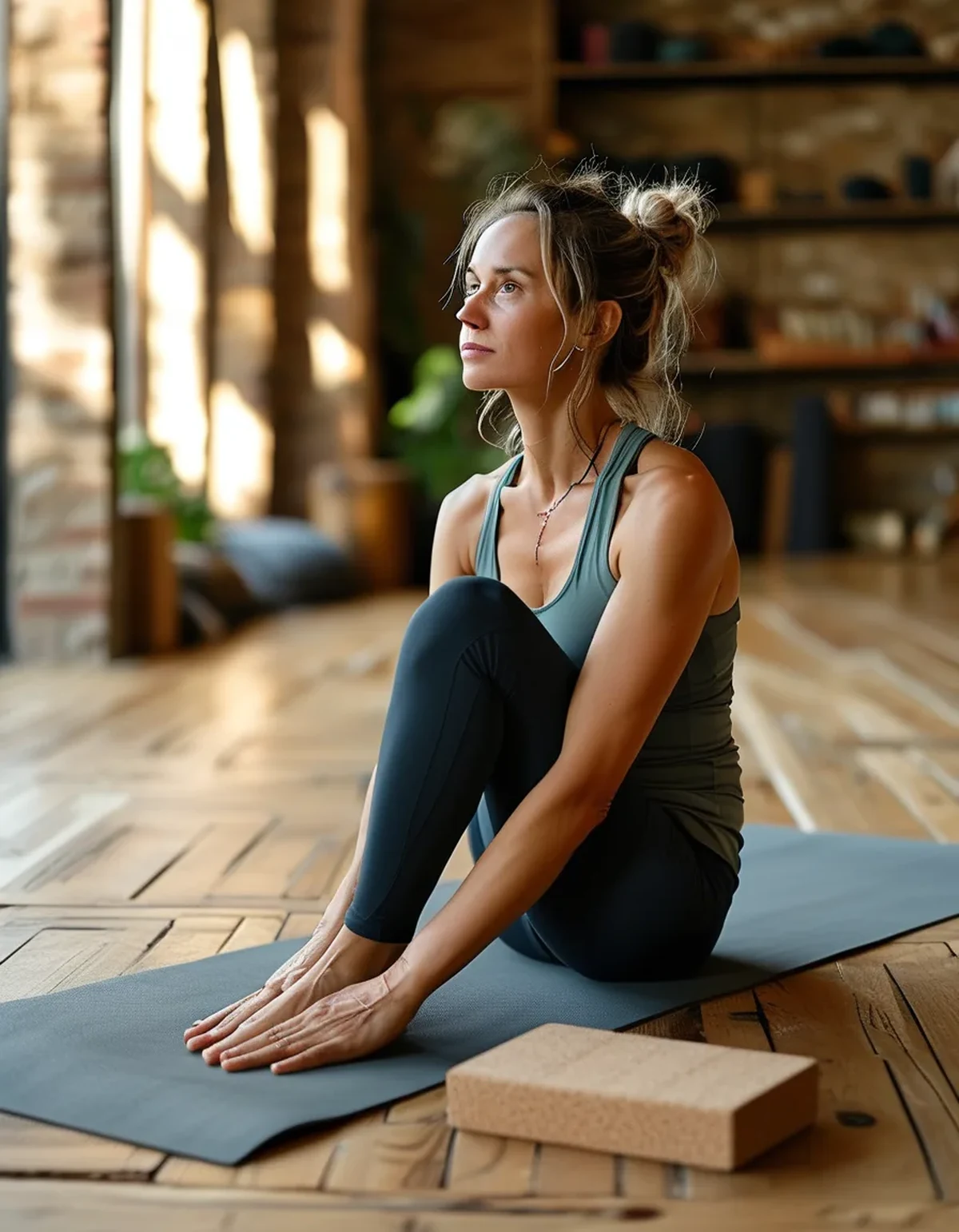
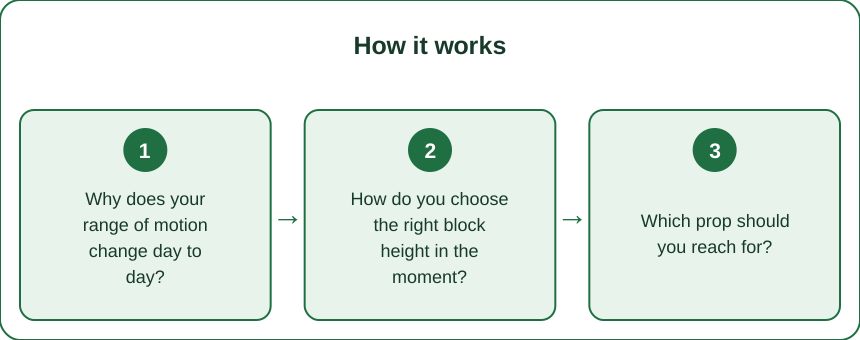
Why does your range of motion change day to day?
Because flexibility is a nervous system output, not a fixed property of your tissues.
Your nervous system sets a limit based on perceived safety. Most of what stops you in a stretch is protective muscle tension rather than physical tissue length. That protective setting responds to sleep, stress, temperature, and recent training.
Tissue temperature changes stiffness substantially. Warm connective tissue deforms more easily than cool. A morning practice in a cool room and an evening practice after a walk are genuinely different bodies, and the difference is larger than most people expect.
Time since waking matters a great deal. Spinal discs absorb fluid overnight, which makes you measurably taller and your spine stiffer in flexion first thing. Forward folds in the first hour after waking are a different proposition from the same fold at noon.
Yesterday’s training leaves residual tension. Muscles that did heavy or unfamiliar work carry more resting tone for a day or two, which reduces available range even when they do not feel sore.
Hydration and sleep both feed in. Poorly slept and mildly dehydrated is a reliable recipe for a stiff practice, and it is usually why a session feels inexplicably harder than the last one.
And stress changes it directly. A high-stress day raises baseline muscle tone throughout the body. This is not imagination, and it is a large part of why practice on a difficult day feels physically restricted rather than only mentally harder.
How do you choose the right block height in the moment?
By what the pose lets you do, not by which height you used last time.
The block should let you hold the shape without straining for the full duration. If you are gripping, holding your breath, or shaking within 15 seconds, the block is too low. Go up a height and the pose becomes a pose rather than a struggle.
Too high is a real problem too. If the block removes all sensation and you are simply resting on it, you have propped yourself out of the pose. There should be a clear stretch or effort, just not a straining one.
Set up at the highest height and work down. Starting high and lowering when it feels easy is far better than starting low, straining, and adjusting mid-pose. It also takes the ego out of the decision entirely.
Expect to change height within a session. By the second half of a practice you are warmer and your available range has increased. Using the same height for the whole class means it was wrong for at least half of it.
Two blocks are dramatically more useful than one. Almost every seated and standing pose benefits from symmetry, and a single block forces asymmetric setups that create their own problems.
Consider what the block is for in each pose. Sometimes it is bringing the floor closer, sometimes it is supporting the pelvis, and sometimes it is providing something to press into for activation. The correct height is different for each of those jobs even in the same pose.
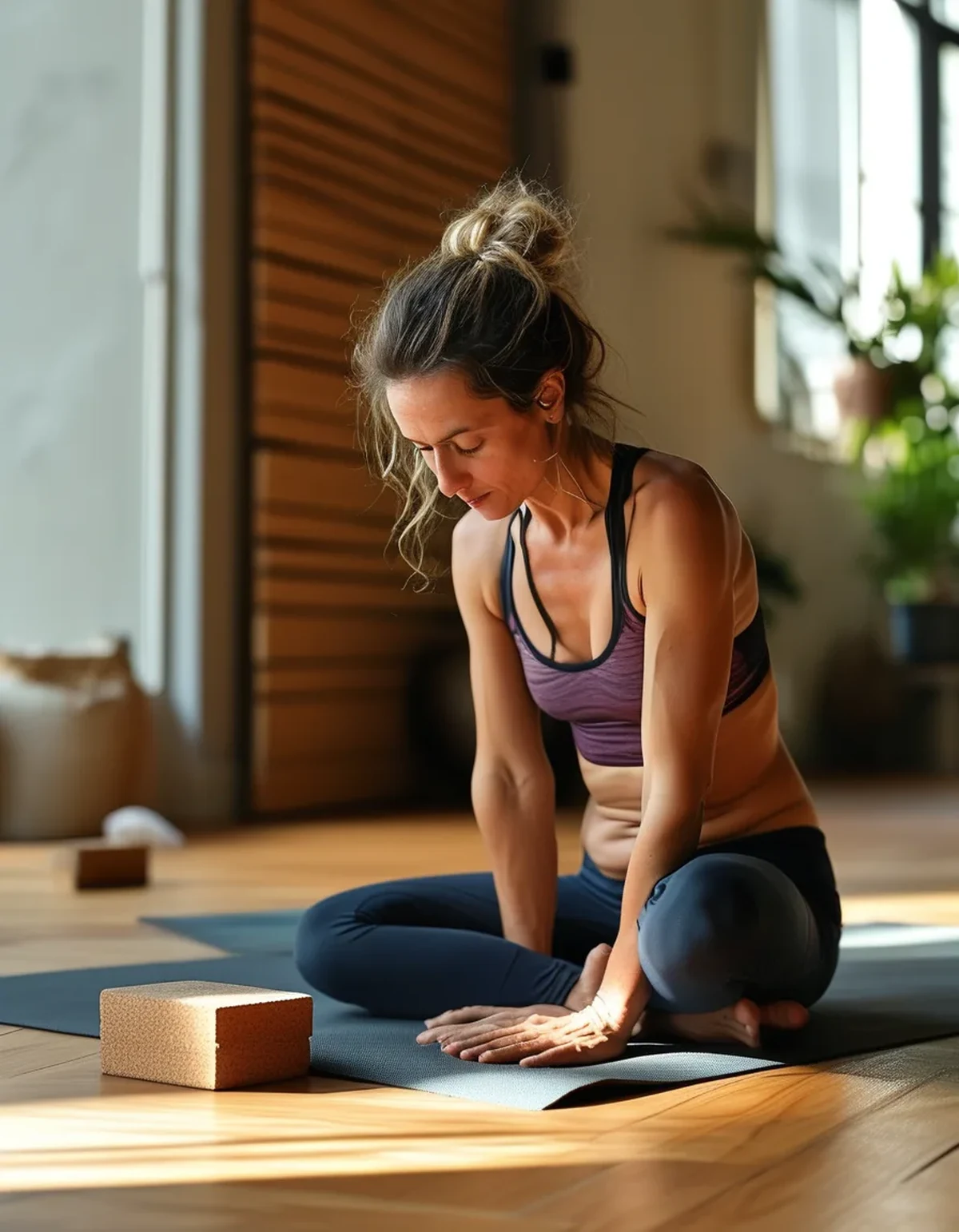
And use blocks under the hips more than you probably do. Sitting on a block in any cross-legged or seated forward fold tilts the pelvis forward and changes the entire pose, and it is the single most under-used prop position for anyone with tight hamstrings or hips.
Which prop should you reach for?
Each one solves a different problem, and using the wrong one is common.
Blocks bring the floor to you or support a body part. Use them when the issue is distance: hands not reaching the ground, hips not reaching the floor, a knee unsupported in the air.
Straps extend your reach. Use them when the issue is a connection you cannot make: hands not meeting behind your back, foot not reachable in a seated fold or a reclined hamstring stretch. A strap does something a block cannot.
Bolsters and folded blankets support weight over time. Use them in restorative poses held for minutes, where the goal is complete relaxation rather than a stretch. A block is too hard and too narrow for this job.
Blankets under knees, ankles, and heads solve pressure problems. Kneeling on a hard floor, sitting with the ankle pressed down, or lying with the head tilted back are all discomfort issues rather than range issues, and a folded blanket fixes them instantly.
A wall is the most under-used prop in the studio. It gives feedback about alignment that no portable prop can, and it makes balance poses accessible without changing the shape at all.
And chairs deserve mention for anyone with knee, hip, or balance concerns. Chair-supported versions of standing poses are not a lesser practice, and the topic has its own depth this blog has touched on elsewhere.
If you have a specific injury or a joint replacement, prop choices are a conversation for a qualified teacher who can see you. This is general information, not medical advice.
Myth vs Fact: Yoga Props
Myth: Using props means you are a beginner. Fact: Experienced practitioners often use more props, not fewer, because they know precisely what each one changes and they are practising the pose rather than approximating it.
Myth: The goal is to eventually stop needing props. Fact: For some poses yes, for many no. A block under the hips in a seated fold improves the pose for most people permanently, regardless of flexibility. Its purpose is pelvic position, not a lack of ability.
Myth: You should use the same block height as last time to track progress. Fact: Daily variation is large enough to swamp genuine progress over any short period. Track over months, not sessions, and set today’s height by today’s body.
Myth: A block is too high if you can technically reach the floor. Fact: Reaching the floor by rounding your back is worse than not reaching it at all. If the block preserves a long spine, the block is correct even when the floor is technically within reach.
Myth: Props are only for tight people. Fact: Hypermobile practitioners often need props more, to prevent sinking past a safe range and to give the body something to press into and stabilise against.
Myth: Cork, foam, and wood blocks are interchangeable. Fact: Foam compresses under weight, which is fine for hands and unhelpful under hips. Cork and wood hold their height under load. If you are sitting or standing on it, use cork or wood.
FAQ: Yoga Blocks, Answered
What height should my yoga block be?
The height that lets you hold the shape without straining for the full duration while still feeling a clear stretch. Start at the highest setting and work down rather than starting low and struggling.
Why can I reach further some days than others?
Available range depends on tissue temperature, sleep, hydration, stress, time since waking, and what you trained yesterday. Flexibility is a nervous system output that varies daily, not a fixed measurement.
Do I need one block or two?
Two. Most standing and seated poses need symmetrical support, and a single block forces asymmetric setups. Two blocks and one strap covers almost everything.
TL;DR:
- Available range varies daily with temperature, sleep, hydration, stress, and time since waking, so props must be set to today’s body.
- Choose block height by whether you can hold the shape without straining, and expect to change it as you warm up mid-practice.
- Blocks solve distance, straps solve reach, bolsters solve long holds, and blankets solve pressure. They are not interchangeable.
- Buy two blocks rather than one, and use cork or wood for anything you sit or stand on.
Setting up at the highest block and working down removes the ego from the decision, and it produces better poses on both stiff days and good ones.
See It in Motion
Seen here: Bootcut Yoga Pants with Side Pockets — shop it on bubblelime.com
Keep Reading
This article is for general informational and styling purposes only. Fit, sizing, and product availability may vary.