Why Your Block Height Should Change Halfway Through Practice
Quick Answer: Your available range increases measurably during a practice as tissue warms and the nervous system settles, so a block height that is correct in the first ten minutes is often too tall by the last twenty. Staying on the same height means you stop working at the edge of your range - the prop goes from support to obstacle. Set blocks tall early, plan to drop a level around the midpoint, and treat height as a variable rather than a setting. The block is a dial, not a decision.
Most people choose a height once and defend it for the whole class.
That is treating a prop like a piece of equipment rather than a tool.
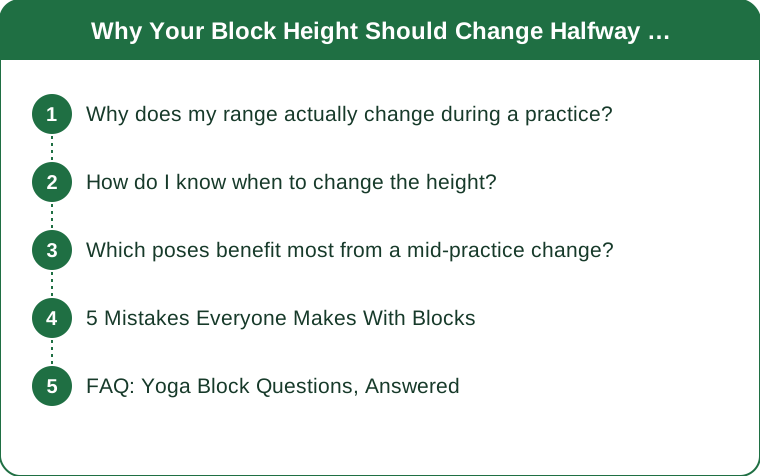
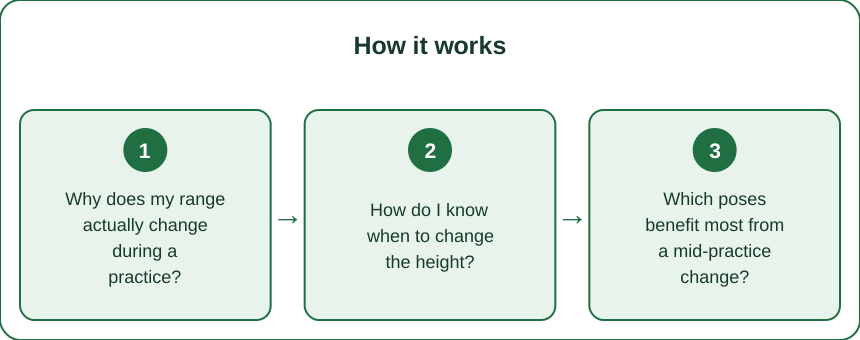
Why does my range actually change during a practice?
Several mechanisms, and none of them are the one people usually cite.
Tissue temperature rises and changes tissue behaviour. Warmer connective tissue deforms more readily under the same load. This is real and it is modest - it accounts for some of the change but not most of it.
The nervous system does most of the work. A large share of your flexibility limit is protective, not structural - the nervous system restricting range because the position is unfamiliar or feels unsafe. As you repeat a shape and nothing bad happens, that restriction relaxes. This is why the third forward fold is deeper than the first, and it happens far faster than any tissue change could explain.
Fluid shifts matter too. Spinal discs are more hydrated in the morning and compress slightly over the day, which changes spinal range noticeably. Your morning practice and your evening practice are different bodies.
And breathing changes what is available. As breathing slows and deepens through a practice, general muscle tone drops. A body at a lower level of arousal simply has more range than the same body twenty minutes earlier.
The combined effect is often substantial - most people can reach several inches further in a standing forward fold at the end of practice than at the start. A block sized for the beginning is genuinely the wrong size by the end.
How do I know when to change the height?
Use a sensation test rather than a clock.
The correct block height is the one where you can reach the position with a long spine and steady breathing, and still feel something. Two things to check, in order.
First, spine before sensation. If reaching the block rounds your back or shortens your breath, the block is too low regardless of how much stretch you feel. Length always outranks depth.
Second, is there anything there? If you reach the block and feel nothing at all - no stretch, no work, no engagement - the block has become furniture. That is the signal to drop a level.
The practical rhythm for a standard class: tallest setting for the first standing sequence, medium through the middle, lowest or none in the final third. Not as a rule but as an expectation you check against.
Watch the breath as the deciding vote. If the breath stays smooth and you can hold the shape for five full breaths without strain, you have room to go lower. If the breath catches or shortens, you went too far and should go back up.
And one important reverse case: sometimes you need to go taller mid-practice. After a demanding sequence, fatigue reduces the control available to hold a position well. Going up a level after hard work is not a step backwards - it is matching the prop to your current capacity, which is the entire point.
Which poses benefit most from a mid-practice change?
The ones where the block is doing a positional job rather than a supportive one.
Standing forward folds and half-splits. These change the most through a practice because hamstring range is heavily influenced by the nervous system. Start on the tall setting, expect to drop at least one level.
Triangle and side angle. The block under the front hand determines your side-body length. A block too tall in the second half means the top ribcage stops rotating open, which is the actual point of the pose. This is the most common case of a prop quietly limiting the shape it was supposed to enable.
Low lunge and pigeon variations. Here you often want to go the other direction - a block under the hip in pigeon may need to stay or even go taller if the hip fatigues, because the goal is a level pelvis, not a low one.
Seated forward folds and any hip opener where you sit on the block. Sitting height should drop as the hips open. Starting on a tall setting and finishing on a low one, or on the floor, is a normal progression within a single practice.
Where not to change: restorative and supported shapes. In a long held restorative pose, the height is chosen for comfort over several minutes and changing it mid-hold defeats the purpose. Set it once, and set it generously.
And the general filter: if the block is holding you up, keep it. If the block is deciding your position, revisit it.
5 Mistakes Everyone Makes With Blocks
1. Treating the lowest height as the goal. The block is not a scoring system. A tall block that lets you keep length in your spine is producing a better pose than a low block that rounds you. Height is not progress.
2. Using one block when two would work better. Symmetrical support in a forward fold or a supported bridge is more stable and lets you relax more completely. Most studios have plenty of blocks and most people take one.
3. Never changing the height in either direction. Covered above and worth repeating because it is nearly universal. The setting from minute five is rarely right at minute fifty.
4. Gripping the block instead of pressing into it. A block is a source of feedback - pressing down into it activates the arm and shoulder and gives you something to work against. Resting a limp hand on top provides almost nothing.
5. Ignoring the third orientation. Blocks have three heights, and most people use two. The medium setting - on its side - is the most useful and least used, and it is often exactly what you want in the middle third of a practice.
FAQ: Yoga Block Questions, Answered
Cork or foam - does it matter?
For weight-bearing, yes. Cork is denser and does not compress, so it gives more reliable feedback and stability under hands. Foam is lighter and kinder for anything under a bone - under the hip in pigeon or under the head in a supported pose. Many people end up with one of each.
How do I know if I am over-relying on props?
You usually are not. The far more common problem is under-use - practising a rounded, strained version of a shape rather than a well-organised supported one. If your breath is smooth and your spine is long, the prop is doing its job.
Should I use blocks at home if I only have one?
Yes, and a stack of books works perfectly well as a second. Consistency of height matters more than the object - a firm book stack at the right height beats no support at all, and lets you practise the mid-practice adjustment this article is about.
TL;DR:
- Range increases through a practice, mostly from nervous system changes rather than tissue warming.
- A block sized in the first ten minutes is usually too tall by the last twenty.
- Check spine length first, then sensation - length always outranks depth.
- Going taller after hard work is correct, not a step backwards.
- Use the medium setting; most people only ever use tallest and lowest.
Next practice, deliberately change your block height once at the midpoint and notice what opens.
See It in Motion
Seen here: High Waist Embossed Yoga Leggings with Side Pockets — shop it on bubblelime.com
Keep Reading
This article is for general informational and styling purposes only. Fit, sizing, and product availability may vary.