A Yoga Block Isn't 'Cheating' — Here's What It's Actually For
Quick Answer: A yoga block isn’t a substitute for flexibility — it’s an alignment tool that lets you access the correct joint angles and muscle engagement of a pose regardless of how flexible you are, which experienced practitioners use just as often as beginners.
You’ve avoided the block because reaching it feels like proof you’re not there yet. But props were never designed as a stepping stone you graduate past — they’re a tool for getting the alignment right, which matters at every level.
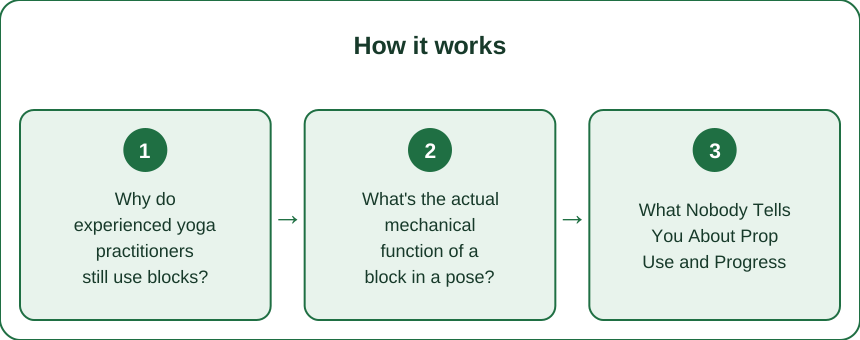
Why do experienced yoga practitioners still use blocks?
Blocks let you maintain correct spine and hip alignment in poses where your flexibility would otherwise force a compensation — like rounding the back in a forward fold just to reach the floor. The pose’s benefit comes from the alignment, not from how close your hand gets to the ground.
An experienced practitioner with tight hamstrings using a block in a forward fold is getting more benefit than someone with loose hamstrings reaching the floor with a rounded spine.
What’s the actual mechanical function of a block in a pose?
In a pose like Half Moon or Triangle, a block effectively raises the floor to meet your hand, allowing your spine to stay in its intended long, neutral position instead of collapsing to close the gap. This preserves the muscle engagement pattern (obliques, glutes, spinal stabilizers) that the pose is designed to train.
Without the block, most people either can’t reach the ground at all, or reach it by compensating with spinal rounding or hip shifting — both of which undermine the pose’s actual purpose.
What Nobody Tells You About Prop Use and Progress
Using a block consistently doesn’t slow your flexibility progress — if anything, poses done with correct alignment via a prop build the right muscle patterns faster than poses forced without one. Many practitioners find they need the block less over time not because they stopped needing support, but because the correctly-trained muscle patterns from prop use built genuine flexibility and strength.
The idea that props are training wheels you should stop needing is backwards — some poses (deep backbends, certain restorative poses) call for props even in advanced practice.
How do you actually choose block height and placement?
Start with the tallest block height in any pose (usually the medium or high setting) and only lower it once you can maintain the pose’s intended alignment at that height without discomfort. Lowering the block too soon reintroduces the same compensation you were trying to avoid.
Placement matters as much as height: in a forward fold, blocks under the hands (not under the forehead) preserve spinal length better for most body proportions.
FAQ: Yoga Prop Questions, Answered
Should beginners eventually stop using blocks entirely?
Not necessarily — many long-term practitioners use blocks regularly for specific poses regardless of flexibility level, since the alignment benefit doesn’t disappear once you’re more flexible.
Do blocks make a pose easier or just different?
They make the correct version of the pose more accessible — it’s not an easier, lesser version, but the properly-aligned version that a compensated attempt without a block often isn’t.
What if I don’t have a yoga block at home?
A thick book, a small stack of towels, or a sturdy box can substitute reasonably well for most standing pose applications where height and stability are what matter.
TL;DR:
- A block preserves correct alignment; it’s not a substitute for flexibility
- Experienced practitioners use blocks as often as beginners, for the same reason
- Prop use builds correct muscle patterns faster than forcing an unsupported pose
- Start with the tallest block height and lower only when alignment holds without it
Stop treating the block as an admission — it’s the tool that gets the pose’s real benefit.
See It in Motion
Seen here: Round Neck Long Sleeve Athletic T-Shirt — shop it on bubblelime.com
Keep Reading
This article is for general informational and styling purposes only. Fit, sizing, and product availability may vary.